mardi 30 décembre 2025

10 Tips for Getting Your Christmas Cactus to Bloom for the Holidays

by


10 Tips for Getting Your Christmas Cactus to Bloom for the Holidays

Thanksgiving Cactus

My Christmas cactus has a sense of humor – a twisted one.

Last year, it finally covered itself in buds right around Valentine’s Day.

The year before? Nothing.

Just green segments gathering dust on the windowsill while everyone else’s plants put on their holiday show.

What am I doing wrong?

Turns out, plenty.

These plants aren’t the foolproof bloomers everyone claims they are – at least not without some specific conditions.

I’ve killed blooms with kindness, moved plants at exactly the wrong moment, and learned the hard way that “easy care” doesn’t mean “blooms on command.”

So I tested what actually works, talked to someone who knows their stuff, and figured out where I’d been going wrong.

Some of these tips surprised me, and that closet trick everyone swears by? Not quite what you think.

Tip 1: Darkness is Your Secret Weapon (But Not How You Think)


You’ve probably heard you need to stick your Christmas cactus in a dark closet for weeks. Not really.

What these plants actually need is consistent darkness at night, 12 to 14 hours of uninterrupted darkness, to be exact.

That means no streetlights streaming through windows, no bathroom light left on, no quick midnight phone checks near the plant.

I tested this by covering mine with a cardboard box each evening starting in early October. Six weeks later? Buds appeared like clockwork.

The trick isn’t total darkness – it’s consistent darkness during nighttime hours, which signals the plant that winter is coming and it’s time to bloom.

Tip 2: Cool Things Down (Yes, Really)

Here’s what clicked for me: Christmas cacti bloom in response to cool fall temperatures, not just short days.

They need nighttime temps between 50-55°F for about a month to set buds.

My breakthrough came when I moved mine to an unheated guest room in October. Within weeks, I had buds forming.

If you don’t have a cool room, try a enclosed porch, garage with a window, or even near (not on) a drafty window.

Just avoid anywhere that dips below 45°F – that’s too much of a good thing.

Tip 3: Stop Overwatering (Even If You Think You’re Not)
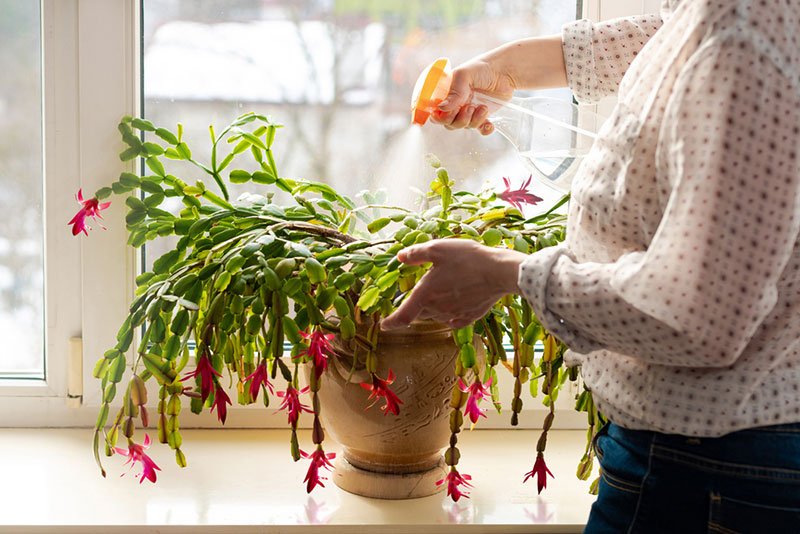
I killed my first Christmas cactus with kindness-specifically, too much water.

These are cacti, after all. During the fall bloom-prep period, they need even less water than usual. If the soil feels damp, don’t water. Period.

Signs you’re overdoing it: mushy stems, yellowing segments, or that slightly funky smell when you stick your finger in the soil. I water mine every 10-14 days in 

October and November, letting the top inch get completely dry between drinks. That mild stress actually encourages blooming.

Tip 4: The Fertilizer Question Everyone Gets Wrong

Here’s the myth: Feed your Christmas cactus right up until it blooms to maximize flowers. Wrong.

Stop fertilizing in September, at least six weeks before you want blooms. Why?

The plant needs to shift from growth mode to reproduction mode, and excess nitrogen keeps it focused on making leaves instead of buds.

I use a balanced liquid fertilizer (like 10-10-10) monthly from spring through August, then nothing until after it finishes blooming.

That fertilizer break was my game-changer.

Tip 5: Location, Location, Location

Don’t put your Christmas cactus near heating vents, in a dark corner, or in that sunny south window.

I moved mine four times the first year! From the kitchen windowsill (too warm) to the dining room (too dark) to the living room bookshelf (finally, just right).

The sweet spot? Bright, indirect light in a cooler room. East or north-facing windows work beautifully.

If your plant’s segments look thin and the color seems pale, it’s not getting enough light. Reddish edges? Too much sun.

Tip 6: Don’t Touch It (Seriously, Stop Fussing)

Once buds form, leave your plant alone. I learned this after rotating mine “just to even out the growth” and watching every single bud drop within three days. Heartbreaking.

Christmas cacti are dramatic about changes once they’ve committed to blooming. Moving them, even turning the pot, can trigger bud drop.

The science: They’ve oriented themselves to their light source, and shifting that relationship stresses them out.

My strategy now? Pick the spot in October and pretend the plant is glued there until December.

Tip 7: Start Your Prep in October (Mark Your Calendar)

Early October: Move it to a cool location, start the darkness routine.

Mid-October: Cut back watering.

Early November: Watch for tiny buds at leaf tips.

Mid-November: Buds should be visible.

December: Blooms!

The timing matters because it takes 6-8 weeks of cool temps and long nights to trigger bud formation.

Note to self: I used to start this in November and wonder why I got February flowers instead of Christmas ones. Those six weeks aren’t negotiable-the plant needs time to shift gears.

Tip 8: Humidity Helps, But Don’t Go Crazy

Christmas cacti are tropical plants that appreciate humidity, but they’re not orchids. Dry air won’t kill them – it just makes blooms less likely.

I tried a pebble tray (meh, barely noticed a difference) and misting (too much work).

What actually worked? Grouping my Christmas cactus with other plants and keeping it away from forced-air heat. That’s it.

If your home’s humidity is above 40%, you’re fine. Below that? A simple pebble tray with water under the pot may help. Good enough beats perfect.

Tip 9: Check Your Variety (Plot Twist!)

Here’s my embarrassing confession: I spent two years trying to get my “Christmas” cactus to bloom in December. It always bloomed in November.

Or was it… a Thanksgiving cactus all along?

Check the leaf edges. Pointed, claw-like projections? Thanksgiving cactus. Rounded, scalloped edges? Christmas cactus. Flat with minimal curves? Easter cactus (blooms in spring).

They need the same care, just different timing. Once I accepted mine was a November bloomer, life got much easier. Know what you’re actually growing.

Tip 10: Accept That Sometimes They’re Just Stubborn

Let’s be honest: Some Christmas cacti march to their own drummer. I’ve done everything right and still had plants bloom in January.

If yours misses the holiday window, don’t toss it. Those late blooms are still gorgeous-and winter could use more flowers anyway.

Keep up the care, enjoy whenever it decides to perform, and maybe try again next fall with adjusted timing.

If your neighbor’s cactus blooms like clockwork every December? More power to them. Yours will bloom when it’s good and ready.



lundi 29 décembre 2025

Crispy Oven-Fried Potatoes & Onions

by
Description

ntroduction

There’s something irresistible about crispy, golden potatoes paired with sweet caramelized onions. This Oven-Fried Potatoes & Onions recipe delivers the perfect balance of crunch and tenderness, with minimal oil and maximum flavor. Whether you’re serving them alongside a juicy steak, a fried egg, or enjoying them solo, these potatoes are a guaranteed crowd-pleaser. The secret? A clever combination of high heat, proper oil distribution, and a touch of patience to achieve that perfect crisp.

The Science Behind the Crisp

Understanding the techniques ensures success:

High Heat (425°F/220°C) – Encourages Maillard browning, creating deep flavor and crispiness.

Preheating the Pan – Jumpstarts cooking, preventing soggy potatoes.

Oil Choice – A high-smoke-point oil (like avocado or refined olive oil) ensures even crisping without burning.

Spreading in a Single Layer – Overcrowding steams the potatoes instead of roasting them.

Ingredients & Substitutions

(Serves 4 as a side dish)

Essential Ingredients:

1.5 lbs (680g) russet or Yukon Gold potatoes – Russets yield crispier results; Yukons are creamier.

1 large yellow onion, thinly sliced

3 tbsp high-heat oil (avocado, refined olive, or vegetable oil)

1 tsp salt, plus more to taste

½ tsp black pepper

½ tsp garlic powder (optional, for extra depth)

½ tsp smoked paprika (optional, for a smoky note)

Substitutions:

Potatoes → Sweet potatoes (adjust cooking time, as they soften faster).

Oil → Melted butter (adds richness but may brown quicker—watch closely).

Seasonings → Rosemary, thyme, or cayenne for a flavor twist.

Step-by-Step Instructions

1. Prep the Potatoes & Onions

Peel (optional) and slice potatoes into ½-inch thick wedges or rounds(uniform size ensures even cooking).

Soak in cold water for 10 minutes(removes excess starch for crispier results). Drain and pat very dry.

Toss with onions, oil, salt, pepper, and any additional seasonings.

2. Preheat & Arrange

Preheat oven to 425°F (220°C) and place a large baking sheet inside to heat up (a hot pan = better browning).

Carefully spread potatoes and onions in a single layer on the hot pan (listen for the sizzle!).

3. Roast to Perfection

Bake for 25 minutes, then flip/stir gently.

Bake another 15–20 minutes until deeply golden and crispy at the edges.

Pro Tips:

Don’t skimp on oil – It’s key for crispiness.

Flip only once – Disturbing them too much prevents browning.

For extra crunch, broil for 1–2 minutesat the end (watch closely!).

Creative Variations

Cheesy Garlic: Toss with grated Parmesan and minced garlic in the last 5 minutes.

Spicy Cajun: Swap paprika for Cajun seasoning.

Herb-Infused: Fresh rosemary or thyme added midway.

Breakfast Style: Top with a fried egg and hot sauce.

Serving Suggestions

Classic Pairings: Grilled meats, roasted chicken, or eggs.

Dip It: Serve with ketchup, aioli, or sour cream.

Bowl Upgrade: Add to grain bowls with avocado and greens.

Final Thoughts

This Crispy Oven-Fried Potatoes & Onionsrecipe proves that indulgence doesn’t require a deep fryer. With a few smart techniques, you’ll achieve deep flavor, irresistible texture, and a dish that’s endlessly adaptable. Give it a try—your next favorite side is just an oven preheat away!

Enjoy!

Potato Salad with Bacon and Eggs

by
Description

Potato Salad with Bacon and Eggs

Potato Salad with Bacon and Eggs
Ingredients:
500 g potatoes
200 g turkey bacon
4 eggs
1 small red onion (optional)
2 tbsp chopped


fresh parsley Salt & pepper to taste

 Preparation:
Cooking potatoes
Cook the potatoes (skin-on or skinless) in boiling salted water until tender. Drain, let cool, then cut into pieces.
Cook the eggs
Cook the eggs for 9 to 10 minutes in boiling water. Refresh them, peel them and then cut them into quarters.
Cooking the bacon
Dry fry the turkey bacon in a skillet until golden brown and crispy.
Make the dressing
Mix the mustard, vinegar, honey (if using), then whisk in the oil. Season with salt and pepper.
Assemble the salad
In a bowl, mix the potatoes, eggs, bacon, chopped red onions and parsley.
Drizzle with the dressing and toss gently.

The area of ​​the building near the door of my neighbor has the aluminum card

by
Description

The fog, glowing with the light of the sole, was impressed by the qualcosa pit nascosto all the inside of the house.

Please start the operation: please see if you have any type of security device or a discreet mode that will pass some time.

One part of me felt like I had too much food, my command rose like an irresistible enigma.

When it turns, if it closes it rings. In fine, it has to do with the lamina, certain that it does not appear too thin.

Leggi di più nella successive pages

You have to say that there is a simple way to verify that there is a certainty of entry into your home.

If the leaf was strapped or danneggiata, it means that some of them have been touched by the handle.

Poiché will be completely intact, will take care of the loro casa fossa al sicuro.

Your review has been updated completely. My feeling is lighter, but this one is lighter and it actually makes you feel safer.

My sono responds to the person who cares for the protection of your horse

All warnings are not obvious and all warnings are not justified if there is controversy.

Ala fine, my sono reso conto che piccoli atti di fiducia possono significare di più ciò che ci aspetta.

see the following pages on the following pages
When my neighbors were on vacation, they left me a message on my answering machine asking if I wanted to cover their doorknob with aluminum foil.

They didn't tell me why and seemed to be in a hurry, so I accepted without thinking too much.

As I stood on the porch with the foil in my hand, I felt a little silly. Nevertheless, I carefully wrapped the lever and made sure it stayed in place. On the way home, I wondered what the point of such a strange request was.

In the days that followed, whenever I passed by them, I always looked at their door.

see the continuation on the next page

Most people have no idea. Grow lavender from cuttings with this ease using this guide

by
Description
Lavender, with its soothing fragrance and vibrant purple blooms, is a beloved plant in gardens around the world. Known for its versatility, lavender can be used in cooking, crafting, and even medicinally. While many people purchase lavender plants from nurseries, growing lavender from cuttings is an economical and rewarding way to expand your garden.
Propagating lavender from cuttings is not only cost-effective but also ensures that you have a genetic clone of the parent plant, preserving its unique characteristics. This guide will walk you through the process, making it easy for even novice gardeners to successfully grow lavender from cuttings.
1. Understanding Lavender: A Brief Overview
Lavender (Lavandula) is a genus of 47 known species of flowering plants in the mint family, Lamiaceae. It is native to the Old World and is found from Cape Verde and the Canary Islands, across Europe to northern and eastern Africa, the Mediterranean, southwest Asia to southeast India. The most commonly cultivated species is Lavandula angustifolia, often referred to as English lavender.
Lavender thrives in well-drained soil and requires full sun to flourish. It is a drought-tolerant plant, making it ideal for regions with hot, dry summers. The plant’s aromatic leaves and flowers are not only attractive to humans but also to pollinators such as bees and butterflies.
2. Why Grow Lavender from Cuttings?
Growing lavender from cuttings has several advantages. Firstly, it is a cost-effective method of propagation, allowing you to expand your garden without purchasing new plants. Secondly, cuttings produce plants that are genetically identical to the parent plant, ensuring that you maintain the specific traits you desire, such as flower color and fragrance.
Additionally, propagating from cuttings can be faster than growing from seeds, as seeds can take a long time to germinate and may not always produce plants true to the parent. By using cuttings, you can expect to see new growth within a few weeks.
3. Choosing the Right Time for Propagation
The best time to take lavender cuttings is during the growing season, typically from late spring to early summer. During this time, the plant is actively growing, and the cuttings are more likely to root successfully. Avoid taking cuttings during the winter months when the plant is dormant.
It’s important to choose a day when the weather is mild and not too hot, as extreme temperatures can stress the cuttings. Early morning is often the best time to take cuttings, as the plant is well-hydrated and less likely to wilt.
4. Selecting the Ideal Lavender Cuttings
When selecting cuttings, look for healthy, non-flowering stems that are about 4 to 6 inches long. The stems should be semi-hardwood, meaning they are not too soft and not too woody. This stage of growth is ideal for rooting.
Make sure to choose cuttings from a healthy parent plant that is free of disease and pests. Avoid taking cuttings from stems that are flowering, as the plant will focus its energy on producing flowers rather than developing roots.
5. Preparing Your Tools and Materials
see next page
Before you begin, gather the necessary tools and materials. You will need a sharp pair of pruning shears or scissors, a clean container for water, rooting hormone, and small pots or trays filled with potting mix. It’s important to sterilize your tools to prevent the spread of disease.
Rooting hormone is not essential, but it can increase the chances of successful rooting. It is available in powder, liquid, or gel form and can be found at most garden centers.
6. Step-by-Step Guide to Taking Cuttings
Begin by using your sterilized pruning shears to cut a 4 to 6-inch section of the lavender stem just below a leaf node. Remove the leaves from the bottom half of the cutting to expose the stem.
Dip the cut end of the stem into rooting hormone, if using, and tap off any excess. This will encourage root development and increase the success rate of your cuttings.
7. Preparing the Potting Mix
Lavender requires well-draining soil to thrive. Prepare a potting mix by combining equal parts of perlite, coarse sand, and peat moss. This mixture will provide the necessary drainage and aeration for the cuttings.
Fill small pots or trays with the potting mix, leaving about an inch of space at the top. Water the mix lightly to ensure it is evenly moist but not waterlogged.
8. Planting the Lavender Cuttings
Using a pencil or your finger, make a small hole in the potting mix for each cutting. Insert the cutting into the hole, ensuring that at least two leaf nodes are buried in the soil. Gently firm the soil around the base of the cutting to hold it in place.
Space the cuttings at least 2 inches apart if planting in a tray, to allow for air circulation and prevent mold growth.
9. Ensuring Optimal Growing Conditions
Place the pots or trays in a warm, bright location, but out of direct sunlight. A temperature of around 70°F (21°C) is ideal for rooting lavender cuttings. Cover the cuttings with a plastic dome or a clear plastic bag to create a humid environment, which will help prevent the cuttings from drying out.
Check the cuttings regularly and mist them with water if the potting mix begins to dry out. Avoid overwatering, as this can lead to rot.
10. Caring for Your Lavender Cuttings
After a few weeks, gently tug on the cuttings to check for resistance, which indicates that roots are forming. Once the cuttings have developed a strong root system, they can be transplanted into larger pots or directly into the garden.
Continue to care for the young plants by providing adequate sunlight and water. Lavender prefers to dry out slightly between waterings, so be careful not to overwater.
11. Troubleshooting Common Issues
If your cuttings are not rooting, check that the potting mix is not too wet or too dry. Ensure that the cuttings are not exposed to direct sunlight, which can cause them to wilt. If mold or rot appears, remove affected cuttings and improve air circulation.
Yellowing leaves can be a sign of overwatering, while wilting may indicate underwatering or excessive heat. Adjust your care routine accordingly to address these issues.

Prepare this remedy with ginger and salt to whiten teeth

by
Description

Prepare this remedy with ginger and salt to whiten teeth

For a radiant smile, it is important to keep your teeth white. Unfortunately, newer whitening methods and kits can be not only expensive, but also harmful to tooth enamel. That’s why there’s nothing better than grandmother’s recipe for white, healthy teeth. For this, Dr. Derek J. Chang recommends two components: salt and ginger. Ginger acts as a powerful antioxidant and relieves pain in the teeth and gums, especially inflammation. Iranian researchers have been able to demonstrate the anti-inflammatory effect of this food, which is similar to that of ibuprofen.

Benefits of salt for teeth It is not trivial to add salt to this natural recipe. In fact, gargling with salt water is the most common way to prevent toothache and gingivitis by tightening living tissue. These are astringent properties that are characteristic only of salt. Benefits of lemon for teeth Dr. Oz emphasizes the therapeutic properties of lemon juice in dental care. However, despite its whitening properties, it is important to use it in small doses as it could have an abrasive effect on your teeth! An easy-to-make recipe While some products, such as coffee, cause stains or yellowing of the teeth, others have exceptional virtues when it comes to making the teeth healthier and whiter. This easy-to-prepare recipe can be a real ally for your dental care. To benefit from its many benefits, first grind the ginger with a grater and then transfer it to a bowl. Add lemon juice and salt and apply this preparation once a week while blow-drying.

Save this recipe, because it's a real treasure. I sent it to everyone who said hello.

by
Description

Ingredients:
1 cooked chicken breast
, 2 carrots cooked over medium heat,
2 tablespoons cream cheese or ricotta,
2 tablespoons mayonnaise (optional for a creamier consistency),
1 clove garlic (optional)
, salt and pepper to taste,
a drizzle of olive oil or lemon juice for a special touch
.  Directions  :

see the continuation on the next pagePreparation :

Cook the chicken breast in salted and seasoned water, if desired (you can steam or boil). Steam
the carrots until very tender.
In a food processor or high-powered blender, combine the shredded chicken, diced carrots, cream cheese, mayonnaise, garlic (if using), and a drizzle of olive oil or lemon juice.
Blend until smooth.
Season with salt and pepper to taste.
Serve cold with toast, breadsticks, pita bread, or crackers.

Ingredients  :

see the continuation on the next pageIngredients  :

1 cooked chicken breast,
2 medium
cooked carrots, 2 tablespoons cream cheese or ricotta,
2 tablespoons mayonnaise (optional, for more cream),
1 clove garlic (optional)
, salt and pepper to taste,
a little olive oil or lemon juice for a special touch
. Directions:

Cook the chicken breast in water with salt and spices to taste (you can steam or boil it).
Cook or boil the carrots until tender and crispy.
In a food processor or high-powered blender, combine the shredded chicken, shredded carrots, cream cheese, mayonnaise, air (if using), and a splash of smoke or lemon juice.
Blend until smooth and creamy.
Season with salt and pepper to taste.
I've served it cold with toast, breadsticks, pita bread, or crackers.

see the continuation on the next page

Why is it worth drinking water on an empty stomach right after waking up?

by
Description

What if the secret to a more energized day, a clearer mind, and a healthier body started with… a simple glass of water? This morning ritual, while seemingly simple, actually holds benefits that are often overlooked. Here's why drinking water first thing in the morning can become your best ally in taking care of your health.

Drinking water in the morning: a discreet ally in weight loss

Looking for a simple and natural way to control your weight? A glass of water after waking up can be your first step towards weight loss. Drinking water on an empty stomach, even before breakfast, helps regulate your appetite. By slightly filling your stomach, it sends a satiety signal to your brain, reducing the need to snack.

But that's not all: your body uses energy to heat the water you consume—a phenomenon called thermogenesis. The result? You burn a few calories without even moving. It's as if your body is gently revving up the engine,   like an oven preheating before cooking  . For those watching their weight, this is   a welcome bonus  .

To keep your brain in top shape from the moment you wake up

Have you ever experienced that foggy mind after waking up? Difficulty concentrating, as if your brain were still under the covers? This could simply be a symptom of overnight dehydration. At night, our bodies naturally lose water, especially through breathing. As a result, our brains work a bit slower in the morning.

Drinking water first thing in the morning helps recharge your mental batteries. It improves memory, lengthens your attention span, and clears your thoughts.   It's like a cold shower for your neurons.

Hydration that makes you smile

Water also affects… our emotions! Even mild dehydration can affect mood, causing fatigue, irritability, or low morale. On the other hand, a good morning hydration can calm you down, restore focus, and even   promote a positive mood  .

This small, seemingly innocent gesture can become a mindfulness ritual: taking a moment for ourselves, sending a message of kindness to our bodies.   A gentle and natural way to start the day well.

For radiant, fresh skin


Drinking water isn't a miracle cure, but it's   the foundation   for healthy, radiant skin. It's a free, natural solution available to everyone.

Benefits for the whole body, from head to toe

Water is involved in almost all important life functions:

  • Helps the kidneys excrete waste;
  • Protects joints by lubricating cartilage;
  • Supports blood circulation and heart health;
  • It also stimulates intestinal transit, which is often slow after waking up.

Simply put, it's the lubricant for our body's machinery. Without it, nothing functions properly.

Tips for enjoying water in the morning

Not a fan of plain water after waking up? Give it a boost naturally:

  • A pinch of lemon juice for a spicy note;
  • A few mint leaves or a cucumber slice for freshness;
  • A hint of ginger or turmeric to stimulate the taste buds;
  • Why not try red fruits that have been cold-treated for a more delicate flavour?

And if you like bubbles, regular sparkling water can be an interesting alternative to the traditional drink in a glass.

How much to drink? Listen to your body.

A glass of water, around 250–500 ml , is ideal in the morning     . However, there's no need to force yourself: drink at your own pace, depending on how thirsty you are. Drinking too much at once is also not beneficial. Spreading hydration throughout the day remains the best strategy.

Remember: a simple gesture brings real benefits

Starting your day with a glass of water is like pressing the “start” button in your body. It stimulates your organs, boosts energy, and improves concentration, digestion, beauty, and mood.

So tomorrow morning, before your coffee or toast, remember this simple gesture: drink a glass of water. Your body will thank you, day after day.

How Often You Should Shower After 65 (And Why Showering Too Often Can Be Bad for Your Health)

by
Description
From a certain age, daily routines should be carefully considered. One of the most painless things—showering—can even weaken your skin without you realizing it. What if we told you that after 65, you shouldn't shower every day? Would you believe it? A fantastic suggestion, but one already widely disproved by experts.
Why skin changes with age
A body that grows, a skin that becomes more refined
As we age, our skin loses some of its natural properties. This is due to a decrease in collagen, elastin, and sebum, the elements that keep skin firm, elastic, and protected.
Think of the skin barrier as a knight's shield: with age, this shield becomes thinner and more fragile. Furthermore, external aggressors such as pollution, cold, chemicals, etc., penetrate it more easily. And showering too often isn't an aggravating factor.
Too many showers, really dry
Warm water and     soap   : reduce mature skin


see continuation on the next page 
see the continuation on the next page
Showering is a joyful, invigorating, almost formal experience. But if the water is too hot and the products are too harsh, we don't just remove dirt: we also damage the skin's natural protective layer.
In people over 65, this causes redness, tightness, itching, and even mild infections. Furthermore, showering too often also alters the skin's microbiome, the invisible flora that helps fight germs.
The perfect frequency: 2 to 3 showers a week
Experts have found that for mature skin, it's best to limit yourself to two or three showers a week. This is enough to stay clean while maintaining the skin's natural hydration.
This method, already used in medicine, is a powerful idea for fragile skin. It helps maintain good hygiene without damaging the epidermis, just as we prefer to clean our car regularly rather than wash it every day.
The right actions in the shower
Selecting the right products makes the difference
Follow these tips when you shower:
  • Moderate, warmer temperature.
  • Gentle, enriched soaps or soap-free shower gels, specially developed for sensitive skin.
  • A short shower, about 5 minutes.
  • Pat dry, do not rub.
  • And above all, moisturize your skin after every shower. A good moisturizer helps replenish the protective barrier damaged by water.
In short: if you take care of your skin, you also take care of yourself.
At any age, but even more so after 65, our skin needs sensitivity, care, and protection. Adapting your personal hygiene routine doesn't mean giving up on cleanliness; on the contrary, it means getting to know your body and preparing it for its true needs.
see continuation on the next page
see the continuation on the next page

Can you solve these puzzles?

by
Description

It's a game that “gets your brain working over drinks with friends or Sunday brunch.” Ten logic puzzles, each more challenging than the last, require no calculator or encyclopedia, just a bit of common sense... and a dash of mischief! So, “ready to test your brainpower?”

  1. Lots of eggs or a morning puzzle

You have 6 eggs. You crack 2, fry 2, and eat 2.
How many eggs do you have left?

Answer: 4.   Yes, you used the same eggs in every step!

  1. Train in tunnel… visible or not?

A 200-meter train enters a 200-meter tunnel.
Is it visible from the outside when it's inside?

Answer: No.   It is located entirely within the tunnel.

  1. Three light bulbs, three switches, one chance


  1. What is the name of the third child?

The father has three sons: Pierre, Paul… and?

Answer:   “The answer lies in the question: “and?”

  1. Strange footprints in the forest

You see a shoe print and a bare foot.

Who was there?

Answer:   Only one person… with one bare foot and one shod foot!

  1. What time is it?

You wake up to find that the clock has stopped ticking. Five minutes ago, it was midnight. In five minutes, it will still be midnight.
Answer:   “It's not a clock, it's an hourglass!”

  1. Born in January… in the middle of summer?

A man born on January 6th claims he was born on a summer day.
Answer:   He was born in  “the Southern Hemisphere, where January is summer!”

  1. How to divide a liter without a measuring cup?

You have 1 liter of water. No measuring cup, no scale.
Answer:   “Tilt the bottle horizontally: when the water level reaches halfway, you have about 500 ml!”

  1. A photo and a family secret

The man says, “The father of the man in the photo is my father's son.”
The answer:   The man in the photo is his son.

  1. All but 9…

A shepherd has 17 sheep. All but 9 flee.
Answer:   9 remain. Words matter!

So how many did you find?

“If you managed to answer 5 or more questions, congratulations: you have a sharp mind!”
And if not, don’t panic… puzzles can be solved just like a good Sudoku: with a smile.

What if true intelligence is the willingness to learn through play?

Which cup would you drink coffee from? A test that will reveal how you react to difficulties.

by
Description

Every morning, we reach for coffee almost automatically. But have you ever considered that the mug you choose can reveal your mindset? What if a simple container revealed your relationship with stress, challenges… and even your decision-making style? Curious? Wait until you find out what your favorite choice says about you!

Ceramic mug: an ally for a calm mind

Are you the type of person who prefers   a nice, thick ceramic mug  with a comfortable handle? Then you're probably a thoughtful, down-to-earth person who likes to take the time to do things right.

You move through life methodically, like making your way through   the morning mist   : slowly but surely. Unexpected events are not your enemy, but you approach them with caution. For you, a solid strategy is better than an uncertain game.

Your strength? Consistency. Both at work and in your personal life, you're trustworthy and encouraging, able to face ups and downs without overdoing it. You deeply believe that perseverance always pays off, a bit like those good old grandma proverbs… which often turn out to be true!

Big Glass: A Tool for Ambitious Multitaskers

Choosing   large, modern, and elegant glassware  speaks volumes about your dynamic and bold personality. You have a thousand ideas a minute and the rare ability to juggle multiple projects with ease.

In a dynamic world, you thrive on adaptability, making decisions quickly, and finding solutions where others see obstacles. What motivates you? Ambitious goals, yes, but always rooted in reality.

Be careful, though   : if you try to do everything at once, you risk forgetting to slow down. A balance between productivity and rest is essential to avoid fatigue. Think of it like charging your phone: even the strongest batteries need breaks!

Disposable Cup: Explorers' Choice

If you drink coffee from a comfortable, practical  paper cup  , you're probably an entrepreneurial person. For you, every new situation is an adventure to be seized, a chance to test, learn, and start over.

You don't wait for everything to be perfect before you start. On the contrary, it's through experimentation that we arrive at our best ideas. The word “failure” doesn't scare you: it's part of the process.

Your mind is sharp, curious, and always focused on what might happen tomorrow. A word of advice? By adding a pinch of planning to your boundless enthusiasm, you can transform your spontaneous flashes of genius into lasting projects.   It's a bit like going from a homemade rocket to a space program with a clear flight plan   !

So, are you more of a cup, glass or mug fan?

Next time you sip your coffee, take a look at your packaging: it may reveal   a lot more than you think  …

The 6 Worst Osteoarthritis Foods You Should Avoid!

by
Description
Osteoarthritis is a degenerative joint disease that affects millions of people worldwide. If you suffer from joint pain, know that your diet plays a key role in the progression of this condition. Certain foods promote inflammation and accelerate cartilage degradation, thus worsening symptoms.

Discover   the 6 worst foods   to avoid if you suffer from osteoarthritis and alternatives for natural joint relief.

1. Sugar and sugary products

Foods high in   refined sugars   (candy, pastries, soda, cookies, etc.) stimulate the production of inflammatory cytokines, molecules that worsen inflammation and joint pain. Furthermore, excessive sugar consumption can promote weight gain, increasing pressure on the joints.

👉  Healthy alternative   : Choose natural sweeteners like honey, maple syrup, or fresh fruit.

continued on the next page 

see the continuation on the next page

2. Red meats and cured meats

Red meats (beef, pork, lamb) and cured meats (sausage, ham, bacon) contain   saturated fats and purines  , which promote inflammation and the formation of uric acid, thus aggravating joint pain.

👉  Healthy alternative   : replace them with   white meat   (chicken, turkey) or plant-based proteins (lentils, chickpeas, tofu).

3. Dairy products

Some dairy products, especially those high in fat (cheese, cream, whole milk), contain a protein called   casein  , which can promote inflammation in some sensitive individuals.

👉  Healthy alternative   : Choose plant-based milk (almond, coconut, soy) and alternative sources of calcium like almonds or green vegetables.

4. Fried foods and processed oils

Fried foods (French fries, donuts, chips) and hydrogenated oils (margarine, palm oil) contain   trans fatty acids  , which increase inflammation and accelerate cartilage destruction.

👉  Healthy alternative   : Choose oils rich in omega-3s such as   olive oil, canola oil, or flaxseed oil  , which have anti-inflammatory properties.

continued on the next page 

see the continuation on the next page

5. Gluten and refined grains

Refined grains (white bread, white pasta, white rice) have a   high glycemic index  , which promotes inflammation in the body. Additionally, the gluten found in wheat, barley, and rye may be poorly tolerated by some people with osteoarthritis.

👉  Healthy alternative   : Choose gluten-free whole grains like   quinoa, buckwheat, and brown rice  .

6. Excess salt

Excessive salt consumption can promote   water retention  , increasing inflammation and putting pressure on the joints. Ultra-processed foods (ready-made meals, canned goods, commercial sauces) are often very high in sodium.

👉  Healthy alternative   : Use   spices and herbs   (turmeric, ginger, thyme) to season your dishes and benefit from their anti-inflammatory benefits.

continued on the next page 

see the continuation on the next page

Follow a healthy diet to relieve osteoarthritis

To protect your joints and reduce pain associated with osteoarthritis, eat an anti-inflammatory diet rich in   fruits, vegetables, good fats, and lean proteins  .

💡  Bonus tip   : Turmeric and ginger are powerful natural allies for fighting inflammation and soothing joint pain. Consider adding them to your diet!

Have you ever tried an anti-inflammatory diet to relieve osteoarthritis? Share your experience in the comments!

continued on the next page

Brighten your smile with simple ingredients

by
Description

A smile changes everything. It's often the first thing people notice, a true indicator of self-confidence. But between coffee, tea, berries, and the passing of the years, our teeth can lose their shine. Good news: there's no need for expensive treatments to restore their shine! With a few simple ingredients you may already have in your kitchen, you can make a real difference. Curious? We'll explain everything.

The Power of Baking Soda (Use with Caution!)

Who would have thought that this everyday ingredient could also become your beauty ally? Baking soda is a gentle abrasive that can help remove surface stains from teeth.   There's no need to overdo it: once a week is more than enough.

Instructions for use:

  1. Mix a teaspoon of baking soda with a few drops of water until it forms a paste.
  2. Apply it to the soft toothbrush, rub gently for a minute (  without pressing  ), then rinse thoroughly.

Result   :   a light polishing effect that can make your smile more defined.

Important note:   This advice isn't for everyone. If you have sensitive teeth, fragile gums, or crowns, consult your dentist before starting.

see the continuation on the next page

Coconut oil: a tradition making a comeback

Another essential ingredient: coconut oil! Used for centuries in Ayurvedic medicine, this plant-based oil has antibacterial properties beneficial for oral hygiene.   And, as a bonus, it can contribute to a mild whitening effect.

How to proceed?

  1. Every morning on an empty stomach, take a tablespoon of coconut oil and gently swish it around your mouth for 5-10 minutes.
  2. Then spit into a trash can (  not the sink  , to avoid clogging) and rinse your mouth with clean water. Do this without rubbing or straining. This technique is called oil  pulling  .

The result:   fresher breath, a clean feeling… and over time, a slightly brighter smile!

Eggshell Powder: A Surprising Mineral Ally


What if we recycled what we throw away most often?   Eggshells, rich in calcium and minerals, can be ground into a fine powder to make a natural homemade toothpaste.   Used occasionally, this powder is said to have a mild remineralizing and polishing effect, ideal for restoring a shine to tooth enamel.

Instructions for use:

  1. Boil the eggshells for a few minutes to sterilize them, dry them, and then blend them until you obtain a very fine powder.
  2. Then, mix half a teaspoon of this powder with a little coconut oil or a few drops of water.
  3. Apply to a soft toothbrush and brush gently for one minute.

Caution:   This method is not a substitute for professional care. Make sure to grind the shells into a very fine powder to avoid any abrasive effects.

The result: a clean feeling and a slightly brightened smile, without damaging the enamel.

A strawberry that makes you smile like a star?

Yes, you read that right! Strawberries contain malic acid, a natural enzyme that can help remove surface stains. Plus, they're delicious... but be warned, this trick should only be used occasionally.

Homemade recipe:

  1. Mash a ripe strawberry, add a pinch of baking soda and apply it to your teeth using a very soft toothbrush.
  2. Leave on for a minute, then rinse thoroughly.

Limit to a maximum of once a week.

Perfect for a quick touch-up before a special occasion.   But be careful: fruit is acidic and, in large quantities, can weaken your nail polish.

The key to a lasting smile? A very simple routine.

We can't stress this enough: no trick can replace good oral hygiene. To prolong the effects of these natural remedies:

  • Brush your teeth twice a day with a fluoride toothpaste.
  • Use dental floss or interdental brushes daily.
  • See your dentist once or twice a year, even if you don't feel pain.

Because it is by combining these simple gestures with some well-chosen natural precautions that you will obtain the best results,   while respecting your teeth  .

So, ready to shine? A radiant smile can start with just a few minutes of attention each week.

see the continuation on the next page

Here's how to open a can in an emergency (it's super easy!)

by
Description
The zombie apocalypse has arrived, and you're waiting in the cellar for it to pass. You managed to grab a potty, a few novels, and several cans of food before closing the cellar door, but you forgot the can opener! What now?
CAUTION: These can-opening methods, while useful in certain situations, create a sharp, jagged edge on the lid. Use extreme caution when performing any of these methods; wearing cut-resistant safety gloves is recommended.
Announcement
1. Spoon
With strong wrists and a sturdy spoon, you should be able to remove the lid from your canned goods.
Grip the spoon firmly in your fist and rub the tip back and forth along the edge of the lid.
 

Then, slide the spoon back and forth along the rim, opening the can as you do so.

That's it!  

You can apply the same technique with a screwdriver, butter knife, or any other similar tool.  
2. Chef's knife

see continuation on the next page

see the continuation on the next page

2. Chef's knife

With a little practice, you'll find that a chef's knife can be a relatively safe tool for opening cans.  

Grip the knife firmly by the handle, placing your thumb on the flat part of the blade, just above the heel.
Keeping the blade pointing away from you, insert the heel into the groove on the rim of the jar.  

A firm downward push should pierce the can lid. Repeat the motion all around the lid.  
 
In a few seconds the can will open!  

3. Concrete


see continuation on the next page

see the continuation on the next page
3. Concrete
If you have concrete in your basement, you're in luck: you don't even need tools to open cans!
Simply rub the top of the can against the concrete to wear down the edge of the lid.  

When the rim is sufficiently worn (as you can tell if you see moisture on the lid), clean off the filings, then squeeze the can and the lid will pop off.

This technique requires a little strength and a little patience!

Of course, the smartest thing to do is plan ahead and make sure to include a manual can opener in your shelter-in-place kit. But if a zombie apocalypse or camping accident catches you by surprise, you certainly don't have to starve.
see the continuation on the next page

This 2-Minute Detox Drink Helps Burn Fat, Lower Blood Sugar, and Lower High Blood Pressure

by
Description

Illnesses. Sometimes they're easy to treat, other times not so easy. Still, managing multiple health issues at once can be quite a challenge. But it can be done.

The following detox drink can cleanse your body of toxins. It helps you heal naturally by boosting your metabolism, burning excess fat, lowering blood pressure, and, most importantly, fighting diabetes.

If you think it's too good to be true, try it yourself and see the positive results.

Recipe for an amazing detox drink:

Ingredients:

1 teaspoon cinnamon
2 tablespoons apple cider vinegar
2 tablespoons freshly squeezed lemon juice
1 tablespoon raw honey
350 to 500 ml or a glass of water
Preparation and consumption:

Here's what you'll find inside.

detox drink2

Cinnamon is a wonderful spice known for its ability to maintain healthy glucose levels and improve insulin sensitivity in patients with type 2 diabetes, according to a study published in the journal Proceedings of the Nutrition Society. It was found that supplementation with Cr (a compound found in cinnamon) in people with type 2 diabetes improved glucose, insulin, cholesterol, and HbA1c levels.

Apple cider vinegar can lower blood pressure when consumed daily because it contains acetic acid, a compound known to lower blood pressure and hypertension. The antihypertensive effects of acetic acid and vinegar were demonstrated in a study published in the journal Bioscience, Biotechnology and Biochemistry, in which rats with spontaneous hypertension showed significant decreases in blood pressure and renin activity after administration of either acetic acid or vinegar.

Lemon juice is a good source of flavonoids, known for their antioxidant properties. Vitamin C is the most abundant antioxidant in lemons. Thanks to its antioxidant content, lemon juice helps fight free radicals in the body, strengthening the immune system. Lemon's antioxidant properties are confirmed by studies showing that the flavonoids in lemons inhibit oxidative stress in diabetic rats.

Honey offers numerous benefits for our bodies thanks to its diverse nutrients, from enzymes, minerals, and vitamins to polyphenols. This is confirmed by an article published in the Journal of the American College of Nutrition. In short, honey contains many healthy ingredients that promote good health.

How many triangles do you see in this image?

by
Description

You thought you had the right answer, and yet... this famous puzzle is puzzling to even the most experienced eye! At first glance, you count a few triangles, then add them up as you progress through the “levels.” Simple? Not quite. The figure—a large triangle divided by three parallel lines at the base—hides more shapes than you can imagine. Ready to outsmart the trick and shine at your next quiz night? Follow the guide.

The Hidden Triangle Trap

Our brain loves to identify the most obvious small triangles and… forget the larger ones, formed by combining multiple areas. The result: we underestimate. In the classic configuration (4 rows formed by 3 lines parallel to the base), the correct answer is 27.  If
you got 26, you most likely missed a large compound triangle, often a triangle with the tip pointing upwards that extends over 3 levels, or a triangle “half-wide” on one side.

Step-by-step method: counting without mistakes

Identify the “upward” triangles by their height:
  • Level height 1:10
  • Height 2 levels: 6
  • Height 3 levels: 3
  • Height 4 levels: 1

Subtotal “up”: 10 + 6 + 3 + 1 = 20.

Add the “downward-facing” triangles resulting from the nesting of the segments: 7.

Total: 20 + 7 = 27.
Memory tip: think “20 ​​on top + 7 on the bottom” and you will avoid the classic forgetfulness.

see the continuation on the next page

The magic formula explained simply

Looking for an elegant shortcut? For a large triangle divided into   n   segments arranged by lines parallel to the base (here   n   = 4), we can use the following formula:

T(n) = n × (n + 2) × (2n + 1) ÷ 8

Applied to   n   = 4:
T = 4 × 6 × 9 ÷ 8 = 27

This result   corresponds perfectly to our step-by-step counting. The beauty of this formula is that it “counts” all possible dimensions, including multilevel combinations. Ideal for testing your intuition... or for silencing a heated debate!

see the continuation on the next page

Common Mistakes (and How to Avoid Them)

  • Counting “by levels” without checking for large cross triangles: The typical culprit is a forgotten 3-level triangle.
  • We omit the inverted (“downward”) triangles: they are less visible, but still present (7 in total).
  • Add imaginary vertical lines: Some puzzle variations include real vertical lines, which change the total (but never to 26). Make sure you've set the position correctly before finishing.
  • Double some triangles: follow a logical progression based on size to avoid duplicates.

Want to learn more?

  • Change the number of rows: Try the formula with   n   = 3 or   n   = 5 and compare it to a manual count – perfect for training the eye.
  • Time yourself: Give yourself 60 seconds to reach 27. The secret? Count the “up” part first, then add the “down” part.
  • Tell a friend: teach a trick and you'll remember it forever (and win your next puzzle battle).

Because behind a simple triangle often hides a little lesson in logic... and the discreet pleasure of having the last word!

see the continuation on the next page