mercredi 4 mars 2026

Headlights too bright? Why are more and more drivers struggling to see the road?

by


The Evolution of Vehicle Headlights

To understand why headlights feel blinding today, it helps to look at how they have evolved.

For decades, vehicles primarily used halogen bulbs. These lights emitted a relatively warm, yellowish glow and had limited brightness compared to today’s standards. They illuminated the road ahead adequately but rarely overwhelmed oncoming drivers.

In the early 2000s, automakers began shifting toward newer technologies:

  • High-Intensity Discharge (HID) lights

  • Light Emitting Diodes (LEDs)

  • Laser-based lighting systems

These newer systems are significantly brighter and more energy-efficient than traditional halogen bulbs. They also tend to emit a cooler, whiter or bluish light. While this improves visibility for the driver using them, it can be much harsher for others on the road.


Are Headlights Actually Brighter Today?

In many cases, yes.

Modern LED and HID headlights can produce much higher lumen outputs than traditional halogen bulbs. The light is not only brighter but also more focused. Instead of diffusing broadly, it is often directed in a sharp, intense beam designed to maximize visibility distance.

However, brightness alone is not the only factor. The color temperature of the light plays a major role. Traditional halogen bulbs typically emit light around 3,000 Kelvin, which appears warm and yellowish. Modern LEDs often operate around 5,000 to 6,500 Kelvin, producing a cool white or bluish tone.

The human eye is more sensitive to blue-rich light at night, and this can increase glare and discomfort.


The Science of Night Vision and Glare

Night driving relies heavily on the eye’s ability to adapt to low-light conditions. This process, known as dark adaptation, allows the retina to become more sensitive in dim environments.

When a bright, blue-white LED headlight suddenly enters the field of vision, it disrupts this adaptation. The result can be:

  • Temporary blindness (known as disability glare)

  • Reduced contrast sensitivity

  • Slower recovery time after exposure

Disability glare occurs when intense light scatters within the eye, creating a “veil” over vision that reduces the ability to see objects clearly. This can last several seconds after the bright light passes—precious time when driving at highway speeds.

Older drivers are particularly affected because the aging eye scatters light more easily, making glare worse.


Vehicle Design Trends and Ride Height

Another major factor contributing to the perception of overly bright headlights is vehicle size.

In recent years, SUVs and pickup trucks have become increasingly popular. These vehicles sit higher off the ground compared to sedans. When a taller vehicle approaches a lower one, its headlights are positioned at a level closer to the other driver’s eye line.

This height difference can make even properly adjusted headlights seem blinding. The issue is especially noticeable in urban areas with mixed vehicle types sharing the same roads.


Misaligned Headlights and Aftermarket Modifications

Not all glare problems stem from factory-installed systems.

Some drivers install aftermarket LED or HID kits into housings designed for halogen bulbs. This can create excessive glare because the reflector housing was not engineered for the new light source.

Additionally, headlights can become misaligned over time due to:

  • Suspension changes

  • Accidents

  • Heavy cargo loads

  • Improper installation

When headlights are aimed too high, they shine directly into the eyes of oncoming drivers rather than illuminating the road surface.


The Role of Automatic High Beams

Many modern vehicles now include automatic high-beam systems. These systems are designed to switch between high and low beams based on detected traffic conditions.

While the technology aims to improve safety, it is not always perfect. Drivers report situations where automatic systems:

  • Fail to dim quickly enough

  • React too slowly on winding roads

  • Misinterpret reflective signs as vehicles

This can result in brief but intense bursts of glare.


Regulatory Standards and Brightness Limits

Headlight brightness is regulated in many countries, but standards vary.

In the United States, headlight regulations are overseen by federal safety standards. In Europe, adaptive driving beam (ADB) technology has been widely adopted, allowing headlights to automatically adjust beam patterns to avoid shining directly into other drivers’ eyes while maintaining maximum illumination elsewhere.

Adaptive systems can dim specific portions of the beam in real time. However, widespread adoption of such advanced technology varies by region and vehicle model.


Adaptive Driving Beam Technology

Adaptive driving beam (ADB) systems use cameras and sensors to detect oncoming traffic and adjust the headlight beam pattern accordingly.

Instead of switching entirely between high and low beams, ADB systems create “shadow zones” around detected vehicles while keeping the rest of the road brightly lit.

In theory, this reduces glare significantly. However, these systems are generally found in newer or higher-end vehicles, limiting their reach.


The Aging Driving Population

Demographics also play a role in the perception of brighter headlights.

Many countries have aging populations, and older drivers are more sensitive to glare. As the lens inside the eye ages, it becomes less transparent and scatters more light.

This means that the same headlight intensity that might be tolerable for a 25-year-old driver could feel blinding to someone over 60.

Increased complaints may partly reflect this demographic shift.


Psychological Factors

Perception matters.

Even if headlights are technically within legal limits, the experience of being dazzled can feel alarming. Bright, blue-toned lights can appear more aggressive or intense compared to warm yellow light.

Social media discussions may also amplify the issue, increasing awareness and reinforcing shared frustration.


Are Brighter Headlights Improving Safety?

Manufacturers argue that brighter headlights improve safety by:

  • Increasing forward visibility distance

  • Enhancing contrast

  • Allowing earlier detection of hazards

Better illumination can help drivers spot pedestrians, animals, and obstacles sooner.

However, if increased brightness causes more glare for other drivers, it could potentially create new safety risks. The balance between visibility and glare control is delicate.


The Pedestrian Safety Debate

One argument in favor of brighter headlights is pedestrian safety.

Modern urban environments are more complex, with cyclists, electric scooters, and pedestrians sharing the roadway. Brighter, whiter light can improve object recognition and reaction times.

But critics argue that blinding glare could make it harder for oncoming drivers to detect pedestrians crossing in front of brightly lit vehicles.


What Drivers Can Do

If you are struggling with bright headlights from other vehicles, several strategies may help:

  1. Avoid looking directly at oncoming headlights. Instead, focus slightly to the right edge of your lane.

  2. Keep your windshield clean inside and out to reduce light scattering.

  3. Ensure your own headlights are properly aligned.

  4. Consider anti-reflective coatings on prescription glasses.

  5. Reduce interior dashboard brightness at night to improve contrast sensitivity.

While these steps cannot eliminate glare, they may reduce its impact.


Industry Response and Innovation

Automakers are aware of consumer concerns. Some manufacturers are investing heavily in smarter lighting systems.

Future headlight systems may incorporate:

  • More precise beam shaping

  • Real-time environmental mapping

  • Communication between vehicles to coordinate lighting

As vehicles become more connected and autonomous, headlight systems may become more responsive and adaptive.


The Balance Between Technology and Comfort

The debate over bright headlights reflects a broader tension in automotive innovation.

New technologies often prioritize performance and efficiency. LED systems last longer, use less energy, and provide superior illumination. From a design perspective, they represent progress.

But technological improvement must consider human comfort and perception. What is optimal in laboratory testing may feel overwhelming in real-world conditions.


Public Awareness and Advocacy

Some advocacy groups are calling for stricter regulations on brightness and glare limits. Others are urging better enforcement of headlight alignment standards.

Public feedback plays a role in shaping future safety standards. If complaints continue to grow, regulators may revisit current limits.


The Road Ahead

The issue of bright headlights is unlikely to disappear anytime soon. As vehicles continue to adopt advanced lighting technologies, the conversation will likely intensify.

Solutions may include:

  • Improved adaptive lighting systems

  • Stricter aftermarket regulations

  • Enhanced driver education

  • Refined brightness standards

Ultimately, road safety depends on cooperation among manufacturers, regulators, and drivers.

She Took My Grandson Away After I Raised Him — Years Later, He Returned Changed

by


She Took My Grandson Away After I Raised Him — Years Later, He Returned Changed


There are heartbreaks you expect in life — the kind that come with warning signs, the kind you can prepare yourself for. And then there are the heartbreaks that arrive without ceremony, rearranging the furniture of your soul overnight.


The day she took my grandson away was that kind of heartbreak.


I had raised him from the time he was six months old. His mother — my daughter-in-law — was young, overwhelmed, and navigating battles I won’t detail here out of respect for her privacy. My son was working long shifts out of state. What began as “just for a little while” turned into years of bedtime stories, scraped knees, parent-teacher meetings, and lullabies sung softly under a nightlight shaped like a moon.


I did not plan to become his primary caregiver. But love rarely consults a calendar.


## The Years That Shaped Us


He called me Grandma, of course. But in practice, I was also the one who packed lunches, signed permission slips, and sat in the front row at school assemblies with a camera that was always slightly out of focus.


I learned his fears — thunderstorms, the dark, the first day of school.

I learned his joys — dinosaurs, chocolate chip pancakes, winning at checkers.

I learned the way he would press his forehead against mine when he needed comfort but didn’t have the words to ask for it.


There is something sacred about raising a child. It is equal parts exhaustion and wonder. It is repetition — brushing teeth, tying shoes, reading the same book for the hundredth time — woven with fleeting moments you wish you could bottle forever.


I thought we had time.


## The Day Everything Changed


She showed up on a Tuesday afternoon.


There had been no warning, no long conversation preparing me for what was coming. Just a firm knock on the door and a tight expression I couldn’t quite read.


“I’m ready,” she said.


Ready. The word felt like it belonged to someone else’s story.


Legally, she had every right. She was his mother. She had found steadier ground. She had secured work and housing. The court paperwork was clear. There was no dramatic confrontation — no shouting, no slammed doors.


But the quietness of it all made it more devastating.


He clung to me at first, confused. I told him it would be okay. I told him his mother loved him. I told him I would always be here.


What I didn’t say was that the house would echo without his footsteps.


After they drove away, I walked into his bedroom and sat on the edge of the bed. The dinosaur sheets were still unmade from that morning. A sock lay half-tucked beneath the dresser. The silence was so loud it felt like pressure against my chest.


Grief doesn’t always follow death. Sometimes it follows absence.


## The Long Years of Quiet


In the months that followed, I struggled to redefine my role. I was still his grandmother — but not the one who braided his hair before school or checked under the bed for monsters.


Visits became occasional. Holidays required negotiation. Phone calls were brief and supervised. I tried to stay steady, never criticizing his mother, never expressing my hurt in front of him.


Children absorb more than we realize.


I kept his room intact for years. I washed the dinosaur sheets. I replaced worn-out toys. I left the nightlight plugged in.


Friends told me to move on. “He’s with his mother,” they said, as if love were a zero-sum equation.


But raising a child rewires you. Your body remembers their weight on your hip. Your ears strain for their laughter even when you know it isn’t there.


Time moved forward anyway.


## The Return


He was seventeen when he came back.


Tall — taller than I remembered. Shoulders broader. Voice deeper. There was a knock on the door again, but this one was hesitant.


When I opened it, I almost didn’t recognize him. The boy who once needed help tying his shoes now stood with a duffel bag slung over one shoulder.


“Grandma,” he said.


There are moments when the past and present collide so forcefully you lose your footing. I pulled him into my arms before I could think. He hugged me back, but there was stiffness there — an unfamiliar distance.


He had returned, yes. But he was changed.


## The Weight He Carried


We sat at the kitchen table that first night. The same table where he once colored with crayons and spilled orange juice.


He spoke carefully at first. School had been hard. Moves from apartment to apartment. Arguments. Financial strain. Responsibilities he wasn’t ready for but had taken on anyway.


He had grown up quickly — too quickly.


There were things he didn’t say, but I saw them in his posture. The guardedness. The way he scanned the room before sitting down. The habit of apologizing for taking up space.


Children who experience instability often learn to shrink themselves.


As he spoke, I felt two competing emotions rising inside me: relief that he was home and sorrow for what he had endured.


I wanted to rewind time. I wanted to fix it all. But he wasn’t six anymore. He didn’t need dinosaur sheets and bedtime stories.


He needed understanding.


## Loving the Changed Version


One of the hardest lessons in life is accepting that love cannot freeze people in time.


The grandson who returned was not the same child who had left. He carried new experiences, new defenses, new scars.


At first, I found myself searching for the old version of him. The boy who laughed freely. The child who ran into my arms without hesitation.


But healing requires meeting people where they are — not where you wish they still were.


So I learned him again.


I learned that he preferred quiet evenings to loud gatherings.

I learned that he drank his coffee black now.

I learned that he woke early, not because he had to, but because he had grown used to unpredictability.


Trust, once fractured by time and circumstance, does not rebuild overnight. It forms slowly, like ice thickening across a winter pond.


## The Conversations That Mattered


Over the months that followed, we talked more deeply than we ever had when he was little.


He asked questions about his childhood — about those early years he barely remembered. He wanted to know if he had been happy.


“You were,” I told him. “You were loved.”


He nodded, as if confirming something he had long suspected but never heard aloud.


Sometimes we spoke about his mother, sometimes we didn’t. I refused to frame his story as a tug-of-war between households. Love does not need to compete to be valid.


He carried complicated feelings — gratitude, resentment, confusion. I encouraged him to hold them all without shame. Families are rarely simple.


## The Meaning of Return


When someone returns after years away, it is tempting to see it as a restoration — a return to what was lost.


But it is more accurate to see it as a new beginning built atop old foundations.


His return did not erase the pain of the years apart. It did not undo the nights I cried quietly in his empty room. It did not erase the challenges he faced growing up elsewhere.


But it offered something equally powerful: choice.


He chose to knock on my door.


He chose to come back.


And in that choice was affirmation — that the love poured into those early years had not evaporated. It had remained, steady and waiting.


## The Subtle Signs of Healing


Change does not announce itself with trumpets. It appears in small shifts.


He began leaving his bedroom door open.

He started inviting friends over.

He laughed — not the cautious chuckle from our first week, but a full, unguarded laugh that echoed down the hallway.


One evening, I found him standing in his old room, holding the dinosaur nightlight I had never thrown away.


“You kept it,” he said.


“Of course I did.”


He plugged it in and let it glow for a moment. Not because he needed it, but because it symbolized something constant in a life that had often felt unstable.


## Forgiveness Without Erasure


People often ask if I resented his mother.


Resentment is a heavy thing to carry for years. I chose not to let it define me.


She had her struggles. She had her reasons. The situation was layered and painful for everyone involved.


Forgiveness does not mean pretending harm never occurred. It means refusing to let bitterness consume what remains.


My focus became simple: be the steady place he can land.


## The Grandparent’s Role


Grandparents occupy a unique space in a child’s life. We are not the primary architects of their future, but we are pillars in the background — holding up beams quietly.


Raising him for those early years was not something I sought, but it shaped us both. When he returned, I understood something clearly: love given in childhood leaves fingerprints that time cannot fully erase.


Even when distance intervenes. Even when circumstances change.


He may have left as a little boy, but he returned knowing — somewhere deep down — that this house meant safety.


## Today


He is older now. Working part-time. Considering college. Finding his footing in a world that once felt unsteady beneath him.


We still sit at the same kitchen table. The surface bears scratches from years of use. It has witnessed spilled juice, tense silences, and late-night heart-to-hearts.


Sometimes, when he laughs, I glimpse the six-year-old who once insisted on dinosaur pancakes.


Other times, I see the young man shaped by hardship and resilience.


Both versions are him.


## What I Learned


If there is anything this journey taught me, it is this: love is not erased by distance.


It may stretch. It may ache. It may feel fragile.


But when rooted deeply, it endures.


She took my grandson away after I raised him. For years, I lived with the echo of his absence. And when he returned, he was changed — older, guarded, carrying more than a child ever should.


But he also carried something else.


He carried the memory of being loved.


And sometimes, that is enough to find your way home.


Why Pour Vinegar on Towels: 7 Household Tips That Will Make You Understand That Everything Ingenious Is Simple

by


Managing a household is not as easy as it seems at first glance. You need to have certain knowledge and skills, and also have proven life hacks in your piggy bank that will help you put your clothes in order, clean the kitchen or bathroom, remove old stains and do other household chores in a matter of seconds. Novate.ru gives valuable tips that will help both novice housewives and professionals.

Tip 1: Rub your cutlery with lemon

Lemon gives the cutlery its shine again. / Photo: silverexpo.ru


Even cutlery made of high-quality materials fades over time, and some even rust. It is clear that it is unpleasant to use such forks and spoons even yourself, not to mention offering them to guests. If you do not plan to buy new cutlery in the near future, we recommend that you upgrade the old one. To do this, take a lemon, cut it into two parts and rub it well with half a citrus spoon or a fork that has lost its attractive appearance. Leave the lemon juice for a while, then rinse the devices under warm water and polish them with a soft cloth. There will be no trace of rust, and they will shine like new. Cutlery that does not have severe contamination can be soaked in potato broth. Therefore, do not pour out the water in which the potatoes were boiled – it is better to use it to clean forks and spoons. Half an hour is enough to clean the contaminated areas. After the time has elapsed, remove the utensils from the broth, rinse them in a bowl of warm water and dry them thoroughly.

Tip 2: Remove odors from plastic dishes with mustard or coffee

Plastic has one unpleasant property – it absorbs odors. That’s why we change food containers so often – as soon as we notice that the aroma has eaten into the container and is not removed by any household chemicals, we immediately throw it in the trash and get new dishes. In fact, it is not necessary to change the containers every few months. Try to remove the smell with mustard. It is an excellent absorbent, so the method is really effective. Pour a few tablespoons of mustard powder into a container and shake it well. After that, rub the container with detergent, rinse with warm water and enjoy the result. Instead of mustard, you can also use coffee. It also has excellent absorption properties and can put plastic in order in a few minutes. Pour a few spoons of ground coffee into the container, close the lid tightly and leave it for 24 hours. The second option is to generously grease the container with coffee grounds and put it in the freezer overnight. A great solution against unpleasant aromas.

Tip 3: Fill the lids with hydrogen peroxide

Peroxide attacks the dirt on the glass lid. / Image: technotion zen channel


Housewives who think that the most difficult thing is to clean pans from grease and soot, probably have not yet encountered dirty lids. Usually all the dirt accumulates under the rim, and it is not possible to reach it even with a special narrow brush. In this case, ordinary hydrogen peroxide, which is in every first aid kit, comes to the rescue. Take the lid, pour hydrogen peroxide into it, wait 5-10 minutes until the reaction starts and the antiseptic “eats away” the fat, then rinse the lid with warm water. Peroxide is a powerful cleaner and, in addition, an antiseptic, so you can put the lid in order in no time. And to make the cleaning agent as effective as possible, mix a tablespoon of hydrogen peroxide with two tablespoons of baking soda until a thick gruel is obtained. Pour boiling water over the lid to soften the dirt a little, then apply the paste on it (it is more convenient to do this with a dishwashing sponge or toothbrush). Leave the paste on for 15 minutes, then brush the lid again and rinse it with hot water.

Tip 4: Use foil instead of a metal sponge

We are used to using foil exclusively for cooking, but it has other useful uses that many housewives do not even suspect. For example, you can roll a ball out of foil and use it to wash dishes. This life hack comes to the rescue at the moment when you threw away an old metal scraper, hoping that there was another one in the drawer, but it was not there. In terms of efficiency, foil is in no way inferior to conventional metal sponges, easily copes with grease, soot and other contaminants. However, it should be noted that it cannot be used to clean dishes with a Teflon coating, as there is a risk of damaging it.

Tip 5: Wash your acrylic bathtub with grapefruit

Halve the grapefruit, sprinkle with sugar and rub into the bath. / Image: technotion zen channel

Some of the most popular bathtubs on the market are acrylic bathtubs. They are relatively inexpensive, have a pleasant smooth surface, are easy to repair, lightweight and warm to the touch at room temperature. But at the same time, such plumbing has disadvantages, the main of which is the difficulty of care. An acrylic bathtub can be easily damaged if you do not know what kind of cleaning agents can be used. We immediately advise you to abandon aggressive household chemicals. It is better to use natural remedies, such as grapefruit. Cut it into two parts, pour a small amount of sugar on one half of the citrus and wipe the floor and walls of the bathroom well. In addition to the fact that the fruit perfectly removes impurities, it also gives a pleasant, refreshing aroma. We recommend that you immediately after cleaning take a full water bath and relax with relaxing music.

Tip 6: Remove scratches on the pan with milk

Over time, small scratches appear on the pan. Some remain after aggressive cleaning with metal sponges, some after forks and legs with which we turn pieces of meat, fish and other products during cooking. Be that as it may, these scratches spoil the appearance of the dishes and are very annoying, you just need to pay attention to them. If the scratches are small and shallow, try to eliminate them using the following life hack: heat a pan on the stove, pour milk into it and heat it. Due to the protein structure of milk, a film forms on the bottom and walls of the bowl, which fills the damage and makes it less noticeable.

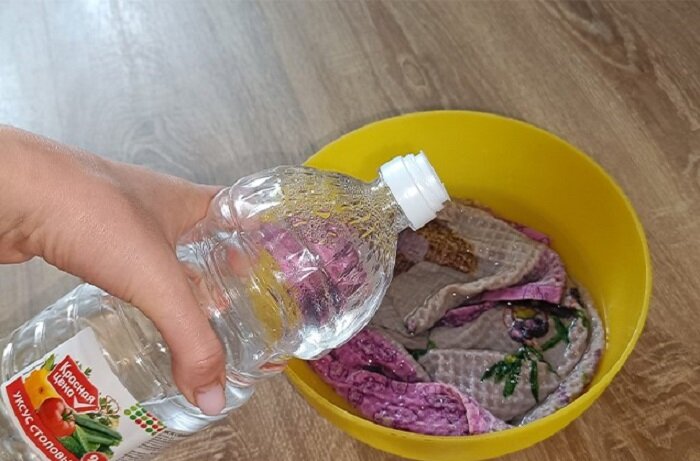
Let the towels stay in the vinegar solution for half an hour. / Image: technotion zen channel

It’s no secret that kitchen towels suffer the most in the house. There are all kinds of dirt on them: greasy stains, traces of food and drinks. That is why most housewives do not even try to buy expensive textiles, because it is very difficult to wash them. It is easier to buy a new set in a month or two than to try to restore the original appearance of the old one. However, there is a secret ingredient that can greatly simplify the washing process and increase its effectiveness. Try to soak dirty towels in a vinegar solution for about 20-30 minutes, then put them in the drum of the washing machine and select the appropriate washing mode. Due to its composition, vinegar is able to destroy greasy stains and other contaminants, which are also the cause of an unpleasant odor. In addition, it softens the fabric, so it washes better.

WARNING — STOP EATING THIS FISH IMMEDIATELY: A COMPLETE HEALTH ALERT & SCIENCE REVIEW (WHAT YOU MUST KNOW BEFORE IT’S TOO LATE)

by


Fish can be an excellent part of a healthy diet, providing important nutrients like omega-3 fatty acids which can lower your risk for diseases like cancer, Alzheimer’s, cardiovascular disease, and dementia, age-related macular degeneration, and rheumatoid arthritis, among others. However, there are certain fish you should never eat. Unfortunately, because of human industrial activity like coal-fired electricity generation, smelting, and the incineration of waste, large amounts of mercury are ending up in our waterways, and subsequently, the fish that swim in them. As this mercury gets into the marine food chain, it “bioaccumulates.”

This means that when smaller fish get eaten by gradually larger fish, the concentration of mercury at each level becomes greater. Consuming too much mercury can be not safe to your health, and cause mercury poisoning. For this reason, the US Food and Drug Administration (FDA) and the US Environmental Protection Agency (EPA) have issued guidelines regarding how much mercury is safe for humans to ingest, and the non-profit Environmental Defense Fund (EDF), provides suggestions for which fish you shouldn’t eat.

1. Tilapia
Did you know that in some regards, eating tilapia is worse than eating bacon? In fact, the shift to eating more farmed fish like tilapia is leading to highly inflammatory diets, according to a 2008 study published in the Journal of the American Dietetic Association.

Wake Forest University School of Medicine researchers say tilapia is one of the most widely consumed fish in America. The problem with that? It contains very low levels of beneficial omega-3 fatty acids and, perhaps worse, very high levels of inflammatory omega-6 fatty acids.

Sustaining high levels of inflammation in the body can worsen symptoms of autoimmune disorders and may be linked to chronic conditions like heart disease, cancer and diabetes.

If you must eat this fish, avoid tilapia from China, where farming practices are particularly worrisome. Better sources are the U.S., Canada, the Netherlands, Ecuador and Peru.

Of course, wild-caught tilapia is preferable to farmed fish but is very hard to find.

1.1 Atlantic Cod

The issue with Atlantic cod is more about the environment and fish populations than human health. This species has been heavily fished for over a thousand years, and by the late 1990s, the fishery collapsed. While fishing for Atlantic cod has significantly decreased since then, the population has had difficulty recovering. Experts agree that the collapse of the fishery has caused lasting changes to the North Atlantic food web, and the species is now classified as vulnerable to extinction.

2. Atlantic Flatfish (halibut, flounder, and sole)

This is yet another example of overfishing and waste. Commercial fisheries produce what’s known as “wasted bycatch,” which occurs when fish or other marine species are unintentionally caught while targeting different species. Every year, U.S. fisheries discard approximately 2 billion pounds of bycatch, which is the equivalent of half a billion meals! The California gillnet fishery, which focuses on halibut, has been singled out as one of the worst offenders. If you’ve eaten halibut in the U.S., there’s a good chance it came from this fishery.

3. Caviar

Caviar comes from the eggs of the Beluga Sturgeon, a centuries-old fish that can live for up to one hundred years. These eggs are in high demand and can fetch thousands of dollars per pound. As a result, the Beluga Sturgeon is now at great risk of extinction. The same threat applies to many other sturgeon species as well.

4. Chilean Bass

Its high mercury content poses a health risk to humans


5. Eel
Eels are slow to mature and have been overfished in many parts of the world, causing some populations to collapse. This is problematic as eels play an important role in spreading mussel populations, which act as natural water filters . In addition, eels absorb and store harmful chemicals and pollutants very easily. This is such a problem that in some areas residents are advised to eat eel no more than once per year.

6. Imported Basa, Swai, Tra, Striped Catfish

These fish, in some cases, are simply labeled “catfish”, and should be avoided. According to a 2016 study, seventy to eighty percent of these fish were contaminated by Vibrio Bacteria, which is what causes most cases of shellfish poisoning

7. Imported Farmed Shrimp

There are various pesticides that are used globally in shrimp production. All but one of them are banned in the United States. On top of that, these shrimps have often been treated with large quantities of antibiotics, and so any time you handle these raw shrimp you run the risk of being infected with antibiotic-resistant bacteria

8. Imported King Crab
Around three-quarters of all crab sold in the United States is imported from Russia, where unsustainable fishing practices are very common. Technically, the only crab that was caught in Alaska can be called “Alaskan King Crab.” However, mislabelling is incredibly common, so you should know where your crab is coming from. If it says “imported” and “Alaskan” on the label, something is amiss and you should stay away.

9. Orange Roughy

These fish can live for many decades and don’t typically reach se-xu-al maturity until they’re at least twenty years old. They are another species that have been overfished, but due to their very slow reproduction cycles, they have an extremely difficult time recovering. Orange Roughy is also known to have high levels of mercury.

10. Shark

Since sharks have very high levels of mercury. They are also slow to mature and reproduce, and thus overfishing has depleted their populations as well.

11. Atlantic Bluefin Tuna
Bluefin tuna are now considered to be highly vulnerable to extinction. They are also large predatory fish and thus contain high levels of mercury.

12. Swordfish

Another predatory fish, mercury is the main concern here. In reality, the EDF has suggested that women and children avoid swordfish altogether and men consume it no more than once per month.

13. King Mackerel
Both King Mackerel and Spanish Mackerel have high levels of mercury and should be avoided, especially by women and children.

14. Grouper
Grouper has moderately high mercury levels and is vulnerable to overfishing [7]. It is also often the target for seafood fraud. The “grouper” that is for sale is may actually be a cheaper form of fish that is being mislabeled. One study found that up to 87% of seafood like grouper, cod, and snapper may be mislabeled

A Note on The Role of Selenium in Mercury Toxicity

Source: WPCouncil.org
If you’re a fan of fish but concerned about mercury toxicity, there’s some good news – many commonly consumed fish are rich in selenium, which may help prevent the absorption of excess mercury. However, there’s a catch. This doesn’t mean you can indulge in as many high-mercury fish as you like. That said, if you do choose to eat fish with higher mercury content occasionally, consuming enough selenium alongside it might help reduce potential negative effects.

The main takeaway is this: If you’re eating fish high in selenium and low to moderately high in mercury, the overall risk is lower. On the other hand, if you’re consuming fish that’s high in mercury but low in selenium (like shark), it’s best to avoid it or eat it very rarely.

Fish To Eat More Of
This does not mean you have to give up fish altogether, but it highlights the importance of reading labels and knowing where your fish is coming from. Wild-caught Alaskan salmon, Pacific Sardines, and Atlantic mackerel are all high in omega-3s, as well as several other nutrients, and have less of a negative impact on the environment. Other good choices include Albacore tuna that was caught in the US or Canada, Alaska Cod, Arctic Char, Rainbow Trout, among others. The EDF Seafood Selector provides a comprehensive list of the best seafood and fish to eat, including where it should come from and how it should be produced.

8 Signs You Have Too Much Sugar in Your Body (And What to Do About It)

by


The Hidden Dangers of Too Much Sugar

Many people consume more sugar than they realize, thanks to hidden sugars in everyday foods like cereal, yogurt, and sauces. These “invisible” sugars add up quickly, pushing intake far beyond healthy limits.

On average, Americans consume over 17 teaspoons of added sugar daily—more than double the recommended amount. Even foods marketed as “healthy” can be loaded with sweeteners.

Excess sugar leads to quick energy spikes followed by crashes, leaving you tired, irritable, and constantly hungry. This rollercoaster effect makes it harder to maintain focus and productivity throughout the day.

Over time, high sugar intake contributes to insulin resistance, hormonal imbalances, and stubborn belly fat. It also accelerates skin aging, causing wrinkles, sagging, and a dull complexion.

The impact isn’t just physical—too much sugar can also harm mental health. Studies link high sugar consumption to increased risks of anxiety, depression, and brain fog.


In more severe cases, prolonged overconsumption damages nerves and signals the onset of prediabetes. Without lifestyle changes, this can progress into type 2 diabetes and other chronic conditions.

The good news? Early action can reverse many of these effects. Reducing added sugars, checking nutrition labels, staying active, and eating balanced meals rich in whole foods can improve energy, skin health, mood, and overall well-being.

Sugar may be sneaky, but awareness is the first step. By recognizing hidden sources and making intentional choices, you can take back control of your health and prevent long-term damage.


NEVER LEAVE A CHARGER IN AN OUTLET WITHOUT YOUR PHONE: I’LL REVEAL THE 3 MAIN REASONS

by


Many people often leave their chargers plugged into outlets even after their devices are fully charged. However, there are several risks associated with this habit that are not widely known.
Risks of Leaving Chargers Plugged In
Continuous Electricity Draw: Chargers have components that draw a small amount of electricity even when not actively charging a device. This standby power consumption, while minimal, can add up over time.
Overheating: Chargers that remain plugged in can overheat. This constant heat can lead to the deterioration of internal components like capacitors, shortening the lifespan of the charger.

Risk of Fire: In cases of sudden voltage spikes, a charger that’s continuously connected to the mains could overheat to the point of smoking or even catching fire. This risk, though rare, can have serious consequences.
Electrical Safety: If you have young children or pets, a plugged-in charger with a dangling cord can be a hazard. It presents a risk of electric shock if tampered with or chewed on.
Preventive Measures
Unplug chargers when not in use to reduce electricity consumption and mitigate the risk of overheating.
Regularly inspect chargers for any signs of damage or wear.
Keep chargers and their cords out of reach of children and pets.
By being aware of these risks and taking simple preventive measures, you can ensure a safer environment in your home and also extend the life of your chargers.

A ‘Wheel of Fortune’ contestant just shocked everyone by solving a $65,000 puzzle instantly!

by


A ‘Wheel of Fortune’ Contestant Just Shocked Everyone by Solving a $65,000 Puzzle Instantly


When it comes to iconic game shows, few have captured the hearts of audiences like Wheel of Fortune. The spinning wheel, the tantalizing puzzle board, and the dramatic pauses before a contestant finally calls out a letter have all become cultural hallmarks. But every so often, a contestant comes along who upends the rhythm of the show entirely.


Last week, a contestant did just that. With a confidence and precision that left both hosts and fellow competitors stunned, they solved a $65,000 puzzle in what seemed like a split second, making history in the process. The moment went viral, reigniting conversations about strategy, quick thinking, and the human mind’s capacity for pattern recognition.


The Contestant Who Dazzled America


The contestant, whose name has become synonymous with puzzle mastery overnight, walked onto the stage with a calm demeanor. Unlike many first-time players, they exuded an aura of quiet confidence, as if they had already memorized the wheel’s spin sequences and had solved countless hypothetical puzzles in their mind before ever stepping foot on stage.


“I just tried to stay calm and focused,” the contestant later told reporters. “I knew that rushing could lead to mistakes, so I read the board, looked for patterns, and went for it.”


The contestant’s background is a study in preparation meeting opportunity. With a passion for word games and competitive puzzle-solving from a young age, they honed their skills through crosswords, online puzzle leagues, and years of observing episodes of Wheel of Fortune to anticipate common puzzle structures.


The Puzzle That Made History


The $65,000 puzzle, in the category of “Phrase,” was notoriously difficult, featuring a multi-word solution with uncommon letters. Most contestants would spend several rounds guessing letters strategically, hoping to reveal enough of the puzzle to make an educated guess.


Yet this contestant bypassed all conventional steps. Within seconds, they scanned the letters, identified the visible patterns, and confidently declared the correct answer. Cameras cut to the audience, whose jaws collectively dropped. The co-hosts froze momentarily before bursting into applause.


This instantaneous solution became a defining moment, not just for the episode, but in Wheel of Fortune history.


Anatomy of the Perfect Solve


Experts analyzing the clip have pointed out several factors that contributed to the contestant’s success:


Pattern Recognition – Experienced puzzle solvers often rely on recognizing common letter pairings, word lengths, and contextual clues. The contestant spotted an unusual but telling combination of letters that hinted at the solution immediately.


Confidence Under Pressure – Many players falter under the glare of studio lights and millions of live viewers. This contestant demonstrated remarkable composure, which psychologists say is a key determinant of rapid decision-making.


Preparation and Observation – Years of watching past episodes allowed the contestant to internalize the types of phrases used, typical pitfalls, and strategic guessing methods. This mental rehearsal meant that when the moment came, their brain could instantly retrieve the solution.


Strategic Letter Selection – While some viewers might assume luck played a role, it was actually a calculated approach. The contestant had pre-selected high-frequency letters that matched the puzzle’s visible gaps, giving them a statistical advantage.


Reactions Across the Nation


Once the episode aired, social media erupted. Clips of the solve were shared millions of times, with viewers marveling at the contestant’s skill. Memes and reaction videos flooded platforms, with comments ranging from awe to incredulity.


One Twitter user wrote:


“I’ve been watching Wheel of Fortune for 20 years, and I’ve never seen anyone solve a $65,000 puzzle that fast. Absolute legend.”


Meanwhile, puzzle enthusiasts dissected the moment, creating step-by-step breakdowns of how the contestant deduced the answer. Online forums buzzed with debates about whether this was luck, skill, or a mix of both.


Behind the Scenes: The Show’s Perspective


Production staff and hosts were equally astonished. Host Pat Sajak commented during the broadcast:


“I thought I had seen it all, but that solve was something else. The audience couldn’t believe it, and neither could we.”


Co-host Vanna White added:


“Moments like this remind you why we do this show. It’s unpredictable, thrilling, and shows the incredible talent out there.”


Producers later revealed that the contestant had gone through the standard vetting and tryout process like everyone else, with nothing to indicate that they would make history on their very first appearance.


A Closer Look at Strategy


For aspiring contestants, this episode has become a masterclass in puzzle-solving strategy. Experts advise focusing on the following techniques:


Memorize Common Phrases: Many puzzles recycle popular sayings or idioms. Familiarity gives an edge.


Learn Letter Frequency: In English, certain letters appear more often in specific positions, giving clues for guessing.


Stay Calm: High-pressure environments can impair judgment. Controlled breathing and visualization help maintain focus.


Observe Patterns: Repeated words or letter combinations across puzzles offer predictive hints.


The contestant applied all these methods flawlessly, turning what could have been a long game into a lightning-fast victory.


Public and Media Response


News outlets quickly picked up the story, with headlines highlighting the contestant’s unprecedented feat. Coverage included interviews, video replays, and even expert commentary from linguists and game theorists.


Some journalists framed it as an example of human cognitive potential under pressure. Cognitive psychologist Dr. Elaine Thomas remarked:


“This contestant’s ability to instantly solve the puzzle demonstrates a combination of pattern recognition, memory recall, and decision-making under stress. It’s an impressive display of applied intelligence.”


Meanwhile, fan communities celebrated the moment as a landmark in Wheel of Fortune history, drawing comparisons to other record-breaking moments on game shows worldwide.


Impact on the Contestant’s Life


The contestant, who previously lived a relatively private life, has suddenly found themselves in the public eye. Interviews, media appearances, and social media followings have surged. Despite the sudden fame, they remain humble, emphasizing the role of preparation and calm thinking.


“I’m just grateful I could do what I love on such a big stage,” they told reporters. “It’s all about enjoying the process and trusting your instincts.”


Cultural Significance of Game Shows


Moments like these are more than entertainment—they reflect cultural fascination with skill, knowledge, and luck. Game shows like Wheel of Fortune serve as modern arenas where intellect meets performance, and contestants become heroes for a brief but bright moment in national consciousness.


The contestant’s $65,000 puzzle solve will likely be remembered as a benchmark of excellence, inspiring viewers and future players to practice, learn, and aim high.


Lessons From the Instant Solve


Several key takeaways emerge from this incredible event:


Preparation Matters – Even natural talent benefits from experience and rehearsal.


Confidence Is Key – A composed mindset can significantly enhance performance under pressure.


Skill Can Outperform Luck – While luck exists in any game, skillful analysis often makes the difference.


Every Moment Counts – Rapid thinking and the ability to act decisively can change outcomes dramatically.


Conclusion


The $65,000 puzzle on Wheel of Fortune wasn’t just a game—it was a showcase of human skill, strategy, and composure. The contestant who solved it instantly demonstrated that with preparation, focus, and confidence, remarkable feats are possible even under the bright lights of live television.


As viewers, we were reminded that the thrill of a game show lies not just in winning, but in witnessing moments that defy expectation. The episode will be replayed, shared, and celebrated for years, inspiring both future contestants and fans alike to dream big, think fast, and always keep their eyes on the puzzle.


This is a story of preparation meeting opportunity, of calm prevailing under pressure, and of a single moment that shocked a nation and etched a contestant into the annals of game show history.